
850 Field Workers Across 5 States. Now Poynter Drops Live Workforce Maps Into Every Bid.
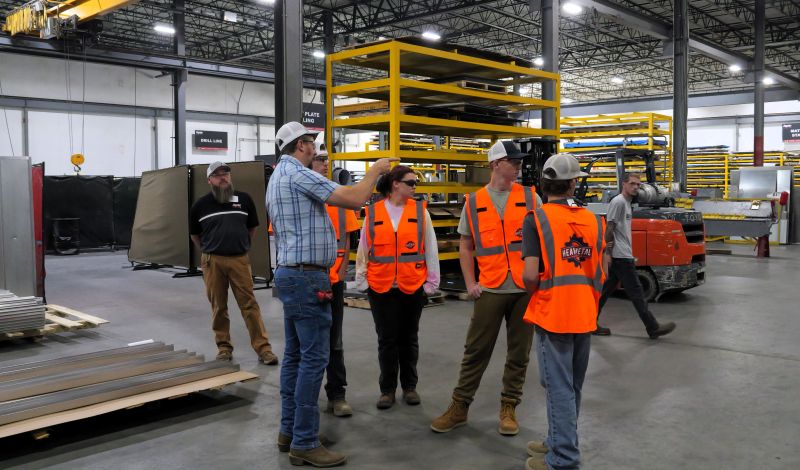
Thanks for joining and being part of the Champ program. A brief introduction and your role? I'm Zach Piercey, vice president of sales at Poynter Sheet Metal. The entire time I've been here I've been in the background doing technology stuff, helping integrate and roll things out. I started in project management, developed a project controls department, then shifted to the sell side — but I work on making the software useful to the end user. Kyle Wilson, I've been with Poynter 15 years, started in the trades and worked my way up. I'm general field superintendent now, in charge of all field labor for the company throughout the country, and the primary user as far as moves with the software — managing over 850 people currently.
Where do you operate? We're in five states right now, throughout most of the Midwest and North Carolina. The majority of our work is Indiana, Kentucky, and western Ohio. We also source prefab for a couple of customers up in Michigan — Kramer is one of our partners.
Biggest takeaway from the workshop so far? It shined some light on focusing on scheduling — it's the hardest thing to do. We have a solid base; we started really implementing about a year ago. It's crazy to see how different it is for Kyle with the resource. Before, it was text messages everywhere. My immediate thought when we first saw it was, holy cow, this is going to move so much work off of Kyle. We're in the dispatching phase looking toward scheduling, and on the back end we can see the forecast — a year ago I wouldn't be comfortable saying how many guys we need a month from now, but now we could get that within 5 to 6 months out.
Labor planning used to be a gut feel — I have too many people, I need to look at layoffs, based on what I thought was coming. Now we're looking at summer projects in May, talking about August. Seeing other contractors, I feel like we're right on pace. It's a huge undertaking to get this firing on all cylinders, so it's reassuring to see the struggles others have had and how they've handled the same issues.
Are you seeing less time on scheduling and dispatch? Before, my process was archaic — I'd send multiple text messages to move one person. The foreman saw the maps, start times, things like that through text. Now I can do that on a computer; more information goes out to more people with less clicks. It took getting used to, but it's an extremely efficient way of moving them, and we have multiple people using the software now where previously I was sending a lot of the messages. We can see what moves have been made, and it all comes through the same way to the field.
It was cool to see a lot of the tangent tasks get completed — OSHA logs, who's got their ten-hour, all of that living with the individual. Our safety guys are using it more. When we did implementation, we realized we'd never updated emergency contact info. Now a foreman gets a new employee and gets all their certifications and who to contact if something happens. One of the biggest time-saving things I didn't foresee is that information I used to reach out to other departments for — email addresses, phone numbers, badging and project info — it's all on the baseball card, and we keep it current. None of the HR or ERP systems are meant for the field or operations team, so it's huge having it in the hands of the people who make decisions about which people are on which projects.
It's cut down drastically on phone calls and text messages. The communication is so much more transparent now between myself and the foreman and the project managers. They get to see who's coming to the projects, where before they had no idea. I had a spreadsheet I kept private — that's how we kept track. It was up to me, after multiple texts and calls, to highlight the spreadsheet and keep everybody in the right spot. It was nowhere near as accurate as what we're doing now.
Are you using RIVET in business development? Turning down work is not in our culture — we're going to go for everything, so it's never a go/no-go decision. It's twofold: it lets us overlay upcoming projects we know are coming, so I can give Kyle a heads-up — here's this job, here's the field hours, the rough schedule. And I'll use it to create manpower curves to send to customers with a proposal. Down to using the employee map — workforce availability is a big thing in our areas. I can pinpoint where a job is going to be, draw a 30-mile radius, and say we have X employees within it. It helps us outshine others. I've even overlaid a project to show a customer it would make up 3% of our company — a little easier to swallow than just saying we can do it.
We've used those labor curves on a couple of jobs to show schedule compression and what it does to the number of people, to help execute change orders. When you cut two or three months off our schedule and the end date doesn't move, this is the increased labor we're seeing. To map that out instead of just saying we have more people — we can show live data and what it's doing to the job. That really helped seal the deal on some of those.
Biggest benefit to the company? On the field side, the ability to execute and set up project teams and scale what I was doing locally. I started doing it in three states, and now we're doing it in five with considerably more people, taking the same process and duplicating it over and over to manage labor and keep everything organized. The transparency throughout the company — I can see who's in North Carolina on which projects, track what locals are there. It makes me wonder how I ever did it with my spreadsheet.
It's cool that Kyle and I look at the same overall manpower chart. We see a drop in January coming down, and that tells me I can get more aggressive on those projects to build backlog. Kyle seeing that, and me making decisions to fill it back up, helps level those peaks and valleys, makes Kyle's job easier, and keeps people employed.
What's it like working with the RIVET team? We have a pretty intricate ERP, and our IT department likes to keep things locked down. Getting the RIVET team integrated with our software and getting the data out of our ERP was probably our biggest success. We write up a job on the sales side and within an hour it's in RIVET and everyone can see it — we put the projection in and adjust the overall manpower. At these events you can see you're wanting to develop the software but also listening to the headaches and ironing them out. We succeed, you succeed — that was a big factor in signing up. The implementation was great; we threw as many hurdles as we could — we're affiliated with other companies, so we needed a wall between the two so we weren't pulling in all the hours — but it went great.
My biggest concern was whether it's user-friendly for myself and our field staff. The Rosie chats and real-time help — you don't feel stuck or lost. When we rolled out, we had a couple of foremen who didn't get signed up with the right email, and within our hour training session we had them up and active. That live support helped put us at ease.
What would you tell other contractors evaluating RIVET? Look at who's scheduling your manpower and how, and what they think four weeks from now looks like. If they're spinning their wheels and can't tell you a range, that was the first thing we thought of when we saw the software. RIVET has probably saved years of Kyle's life with how easy it is getting the information out. It's hard to put a dollar amount on it, but you've got a lens now within all the projects — there's a huge dollar value, and we see it. On my end, the scalability — we talked to contractors managing 100 people and others managing 1,400, and it's the same software. The flexibility really impressed me.
THE CHALLENGE
Poynter Sheet Metal had outgrown the way it moved people. As General Field Superintendent Kyle Wilson — 15 years with the company and the primary user who handles labor moves — put it, the old process was "a bit archaic. I would send multiple text messages to move one person." The foreman saw the maps, start times, and details through a barrage of texts, and the only system of record was a private spreadsheet. "It was up to me, after multiple text messages and phone calls, to go back through and highlight the spreadsheet. It was nowhere near as accurate as what we’re doing now."
At 850-plus field workers across five states — Indiana, Kentucky, western Ohio, and into North Carolina — that approach didn’t scale. Information the field needed lived in HR and ERP systems never built for operations: emergency contacts, certifications, badging and project info that Wilson had to chase across departments. And on the business-development side, VP of Sales Zach Piercey was selling capacity he couldn’t easily prove.
"Before, my process was a bit archaic — I’d send multiple text messages to move one person. Now more information goes out to more people with less clicks. It’s an extremely efficient way of moving them, and it all comes through the same way to the field."

OUR SOLUTION
Poynter put scheduling, dispatch, worker data, and forecasting into one platform — then extended that same data into how it sells work.
One Transparent System, Not a Private Spreadsheet
Moves that took a string of texts now go out to more people in fewer clicks, the same way every time. "The communication is so much more transparent now between myself and the foreman and the project managers," Wilson said. "They get to see who’s coming to the projects — where before, they had no idea." Everything a foreman needs to onboard a new hire — certifications, emergency contacts, badging info — now lives on the worker’s baseball card instead of behind an email chain to other departments.
Labor Curves That Win Work
Poynter never uses RIVET as a go/no-go gate — "we’re going to go for everything." Instead, Piercey overlays upcoming projects to give Wilson a heads-up, and builds manpower curves to send to customers with proposals. Using the employee map, he draws a 30-mile radius around a job and shows exactly how many workers are nearby. "It helps us outshine others," he said. Poynter even overlays a prospective job to show a customer it would be just 3% of the company — "a little easier to swallow than just saying we can do it."
Change Orders Backed by Live Data
When a schedule compresses, the same curves prove the impact. "When you cut two or three months off our schedule and the end date doesn’t move, this is the increased labor we’re seeing," Wilson said. "To be able to map that out instead of just saying we have more people — we can show live data and what it’s doing to the job. That really helped seal the deal on some of those change orders."
ROADBLOCKS
Poynter is about a year into implementation and — reassuringly — "right on track where we should be," Piercey said, after seeing how other contractors at Champ Summit handled the same hurdles. The team built a solid dispatching base first and is now pushing deeper into scheduling and longer-range forecasting, with comfort extending from a few weeks toward five to six months out.
A meaningful early win was the integration itself. Poynter runs an intricate ERP and is affiliated with other companies, so it needed a wall between entities to avoid exposing the wrong hours. "That was probably the biggest success — getting the RIVET team integrated with our software and getting the data out of our ERP," Piercey said. "We write up a job on the sales side and within an hour it’s in RIVET and everyone can see it."
"RIVET has probably saved years of Kyle’s life, honestly, with how easy it is just getting the information out. You’ve got a lens now within all the projects — there’s a huge dollar value there, and we see it."

NEXT STEPS
Poynter’s focus is moving from a strong dispatching base into full scheduling and longer-horizon forecasting, then extending the same repeatable process across all five states as it grows. The leadership team also sees value in how RIVET surfaces shared visibility — Wilson and Piercey now look at the same overall manpower chart, spotting dips months out so sales can get more aggressive on backlog before a valley hits. With the ERP integration humming and Rosie chat support keeping the field unblocked, Poynter plans to keep tightening the loop between what it sells and what it can staff.

THE CLIENT
Poynter Sheet Metal is a sheet metal contractor operating across five states — with the majority of work in Indiana, Kentucky, and western Ohio, extending into North Carolina — and prefabrication partnerships reaching into Michigan. The company manages more than 850 field workers and runs an ERP integrated with RIVET.
Industry:
Sheet Metal Contractor
Location:
Indiana, Kentucky & western Ohio (5 states)
Size:
850+ field workers
Services:
Sheet metal fabrication & installation, prefabrication
FAQs
Find answers to common questions about RIVET’s workforce management solutions and features.
RIVET connects directly with Spectrum, Vista, Viewpoint, Foundation, Sage, COINs, CMIC, and other major construction ERPs through pre-built integrations. We automatically sync job budgets, schedules, and worker data, eliminating double data entry. Most integrations are completed within 1-2 weeks during implementation.
RIVET is designed for construction operations teams, not tech experts. We've helped many superintendents near retirement giving them hours in the day back. Hands-on white glove training with real people ensures your team will always get the support they need.
Most contractors see immediate task-based time savings in scheduling within the first few months. Labor planning impacts and reduction in margin fade from productivity killers takes longer to show up in the numbers, but you will feel the difference.
Most contractors using RIVET have more than 50 field employees performing construction work. We work with some of the largest contractors in the country, planning and scheduling thousands of field personnel. If you're currently managing workforce scheduling with spreadsheets, whiteboards, or phone calls, and have multiple projects running simultaneously, RIVET is for you.
Your data belongs to you. RIVET provides complete data export capabilities in standard formats, and we'll work with you to ensure a smooth transition if you decide to leave.
RIVET was purpose built for electrical and mechanical contractors, and is based on the workforce management best practices of the most successful MEP contractors. RIVET is an active partner with NECA, SMACNA, and construction research organizations like ELECTRI. RIVET is focused exclusively on making labor operations efficient rather than trying to solve every construction problem.
Get Started Today
Construction labor challenges can be greatly reduced with the right software