Why Construction Jobs Run 7% Over: The Research Behind Productivity Risks


Margin fade is hiding in every job plan
If you are a leader in construction you already know this: most jobs run over. Industry benchmarks and our own data both land in the same place. The typical construction job comes in around 7% over its labor hour estimate. The best-run shops push that number below 5%.
But here's the part that doesn't get talked about enough: that overrun isn't random. It isn't weather. It isn't always the GC. Most of it traces back to a small, repeatable set of decisions about how labor gets loaded onto a job. Decisions that, if you can see them early, you can actually do something about.
That's what the new Productivity Risks experience in RIVET is built to surface. The dashboard flags your riskiest jobs, quantifies the hours impact, and points you to the specific risk indicator (which we are calling productivity killers) creating the risk. This article explains the research behind it. Where the thresholds come from, what the data says, and why we chose to measure the three things we did.
The foundation: NECA and MCAA research
The foundation for our work is two studies conducted by Dr. Awad Hanna: Factors Affecting Labor Productivity for Electrical Contractors for ELECTRI and Factors Affecting Productivity for the MCAA. In these studies more than a dozen distinct factors were identified that erode field productivity and, critically, quantified their hours impact using data from more than a hundred real projects.
That research has been sitting on the shelf in the industry for years. The problem is that it's been largely theoretical for most contractors.
- "You have to be a rocket scientist to use this stuff."
- "The GCs are immune to having these studies thrown at them."
While helpful for explaining lost hours after the fact, if you don't have data to back up your claims you are unlikely to get paid for the lost productivity. Measuring overmanning in a spreadsheet after the job is over isn't as helpful as preventing the overmanning or mitigating its impact by having a good plan.
RIVET continues the mission
That's where RIVET has stepped in. Our Productivity Risks dashboard helps contractors operationally address these risk factors before it's too late. We do the rocket science handling of the logarithmic expressions and surface the jobs that you need to address now. Whether through a change in plan or an early conversation with the GC or other trade partner.
We've built our insights engine on anonymized data from tens of thousands of completed projects representing over a hundred million hours of work completed. We've been able to validate Hanna's findings, made sure the effects still hold in 2026, improved their efficacy with an even larger data set, and finally operationalized those findings as real-time flags on jobs that are still in flight.
We went deep on three productivity risk factors first because they're the three you can actually see, measure, and act on from inside the RIVET scheduling and forecasting platform. Here's what each one is and why it matters.
Productivity Risk #1: Overmanning
What it is: Stacking more workers on a job than the plan calls for. It usually happens as a recovery move. The job is behind, so you throw people at it. Sometimes it's planned that way from the start because the schedule was always aggressive.
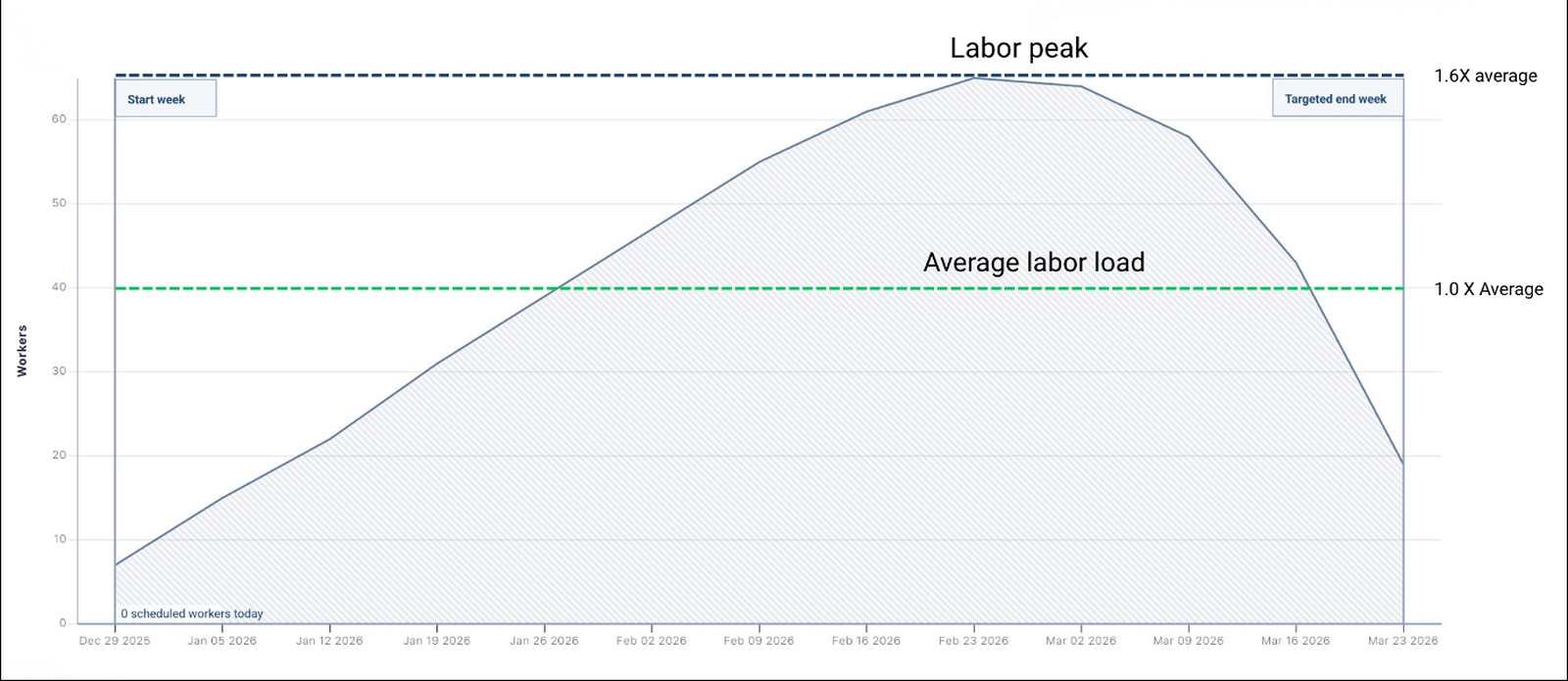
Why it kills productivity: Once you exceed a certain ratio of peak workers to planned average workers, coordination overhead starts consuming the gains. Crews compete for space, materials, and supervisor attention. Communication volume grows faster than output. What looks like "catching up" quietly becomes lost hours.
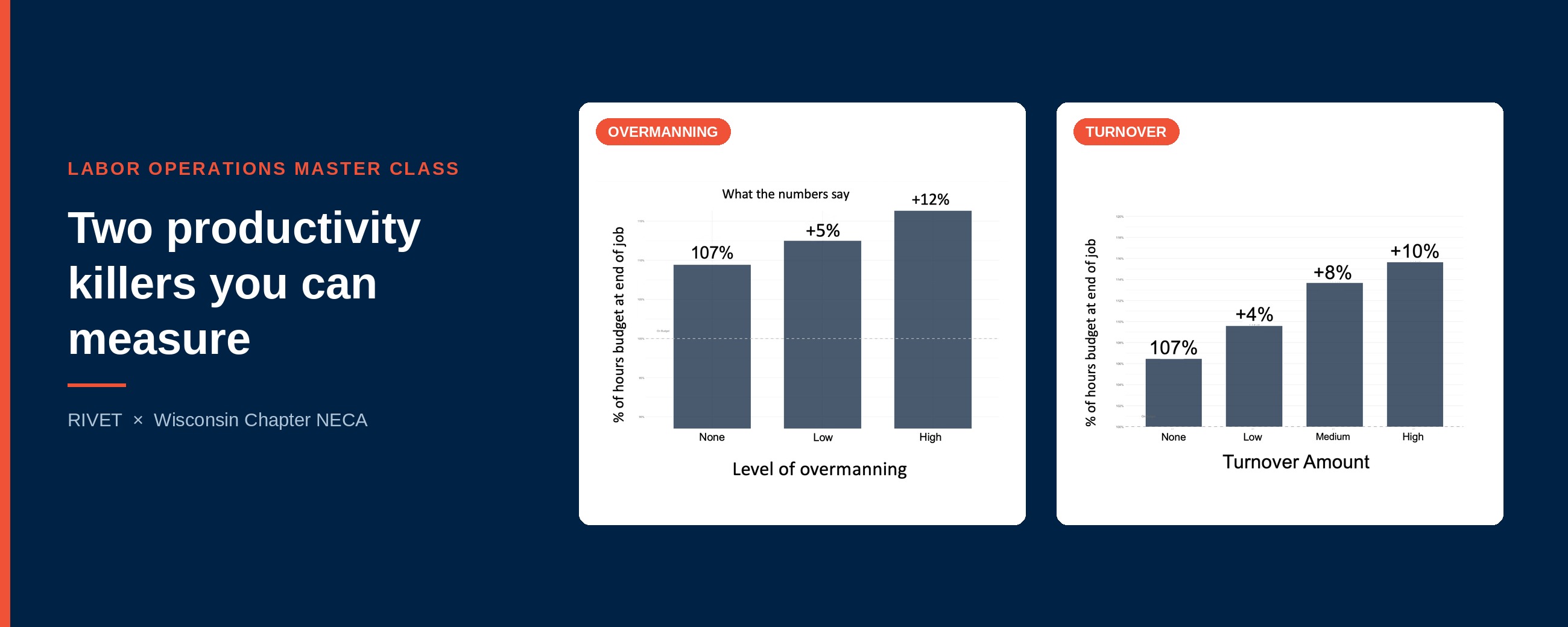
What the research says: Dr. Hanna identified a clear inflection point where productivity losses accelerate. Below that line, you're ramping. Above it, you're paying a tax. His study documented median productivity losses ranging from 15% for minor overmanning to 33% for severe cases.
What RIVET's data confirmed: Across hundreds of scheduled jobs in our analysis, the effect is the clearest and strongest of the three risk factors, and it gets more pronounced as crew size grows. The punchline: jobs with high overmanning ran roughly 15 percentage points worse on hours efficiency than jobs that stayed disciplined. On a $1M labor budget, that's about $150,000 of overrun attributable to how the labor curve was loaded. Dr. Hanna's research predicted the pattern. Our data confirmed the size of the bill.
Productivity Risk #2: Dilution of Supervision
What it is: Supervisors stretched too thin to actually supervise. This often shows up alongside overmanning, but it's a distinct failure on its own. You add bodies to the crew without adding foremen, and one field leader is suddenly trying to direct, coordinate, and answer questions for a team twice the size they should be running.
Why it kills productivity: Dr. Hanna's framing is precise: supervisors become "ineffective in two separate areas instead of being productive in the one originally-planned area." They stop leading and start firefighting. Decisions queue up. Safety exposure climbs because eyes aren't in the right places. Rework grows because nobody catches the problem at the work face. Coaching disappears, which means the next generation of field leaders isn't getting developed either. A crew without effective supervision isn't a crew. It's a group of individuals doing their best with incomplete information.
What the research says: Effective supervision ratios in electrical and mechanical work generally fall in the range of one foreman per six craftworkers for steady-state production. Push past that, and oversight quality drops sharply unless you introduce additional lead journeymen or foremen. The industry has converged on these numbers for a reason: they're what a single human can realistically manage while still doing the coaching, coordinating, and quality-control work that separates a productive crew from a busy one.
What RIVET's data confirmed: Our analysis showed diluted jobs running roughly 4 percentage points worse on hours efficiency than well-supervised ones. On a 10,000-hour job, that's 400 extra hours spent because the foreman couldn't be in two places at once. Scale that across a portfolio of jobs, and it's real money.
Productivity Risk #3: Loss of Learning (Turnover)
What it is: The churn of workers on and off a job. Every time a new person rotates in, the job pays for their ramp-up. Not just the onboarding hours, but the disruption to the crew they join and the knowledge that walks off the site with whoever they replaced.
Why it kills productivity: Construction is a learning-curve business. A crew that's been on a job for six weeks is materially more productive than the same-sized crew on day one. When you cycle through workers faster than the job can absorb them, you're constantly resetting that learning curve. Hanna's research ties this directly to both morale and productivity loss.
What the research says: Industry research defines turnover as the ratio of replacement craftsmen to total craftsmen on a project, and ties it directly to the learning curve. Every replacement worker arrives with zero project-specific knowledge: the layout, the foreman's preferences, where materials are staged, and where the bathrooms are. The crew absorbing them spends more time onboarding and less time installing, and the effect compounds as turnover climbs.
What RIVET's data confirmed: Jobs with high turnover, those that cycled through more than double the unique workers their peak actually required, ran about 10 percentage points worse than jobs with stable crews. And unlike overmanning, the effect held across job sizes. Workforce churn hurts you whether you're running a 1,000-hour service job or a 50,000-hour stadium.
How the three come together
None of these risks is a single cause of failure. In the jobs that really blow up, you usually see two or three of them reinforcing each other: the schedule slips, so the contractor overmans, which dilutes supervision, which drives turnover, which destroys the learning curve. That's why the Productivity Risks dashboard rolls them into a composite view. A job with one risk factor flagged at moderate severity is worth watching. A job with all three is almost certainly already bleeding hours.
It's also why we quantify the impact in hours rather than dollars or percentages. Hours are the currency of construction labor. When the dashboard tells you your at-risk jobs are projected to burn an additional 4,401 hours, that's a number your superintendent and your CFO can both act on.
What we're being careful about
A few things worth naming directly:
- We estimate impact at the portfolio level, not per-job. The research supports aggregate projections of hours lost across a group of jobs. It doesn't support telling you that Job #1996 specifically will overrun by exactly 312 hours. So we don't.
- Thresholds are starting points, not laws of nature. The overmanning thresholds come from electrical research. Mechanical work runs hotter. Some contractors are paid to overman. That's why the dashboard gives you the tools to exclude or dismiss jobs that don't fit your context.
- This is version one. We're continuing to research additional risk factors, including supervisor turnover specifically, journeyworker-to-apprentice ratios, and a broader "good-contractor-practice" index, and we'll roll those in as the evidence solidifies.
What to do with it
If you're an executive or operations leader, the dashboard is built for you. Start at the top of the Composite Impact table, work down through the jobs flagged as high severity, and use the drill-through to understand which risk factor is doing the damage. If you're a project manager or superintendent, the job homepage experience brings the same insights into context on the jobs you own, with a direct link to wherever in RIVET you can take corrective action.
If you want to talk through how your team should put this in motion, how to read the severity rankings against your own portfolio, how to configure thresholds and exclusions for your trade mix, or just what a reasonable first 30 days looks like, reach out to your CSM. They've been in the room for the research and they can help you get more out of it.
The biggest line item on your P&L is finally visible before the month closes. Let's use it.
Further reading
- The Hidden Cost of Labor Planning Chaos in Construction — how daily operational friction shows up as overmanning, excessive overtime, and dilution of supervision.
- The Hidden Margin Killer: How “Loss of Learning” Is Quietly Destroying Your Margin — a closer look at turnover, the learning curve, and how crew churn compounds across a portfolio.
Ready to ditch the chaos?
Join specialty contractors just like you who stopped accepting "that's just construction" as an excuse for losing money.