
Visualizing Workforce Management
For specialty contractors, Workforce Management comes together as a load-bearing bridge with a strong business practice as the foundation
Visualizing Workforce Management usually takes on some kind structure with load-bearing pillars that share the load, supporting by a strong foundation.
The Business Practice is the roof, and then pillars are holding up Field Operations. All of that is resting on a foundation of the Business Practice — People, Process and Technology.
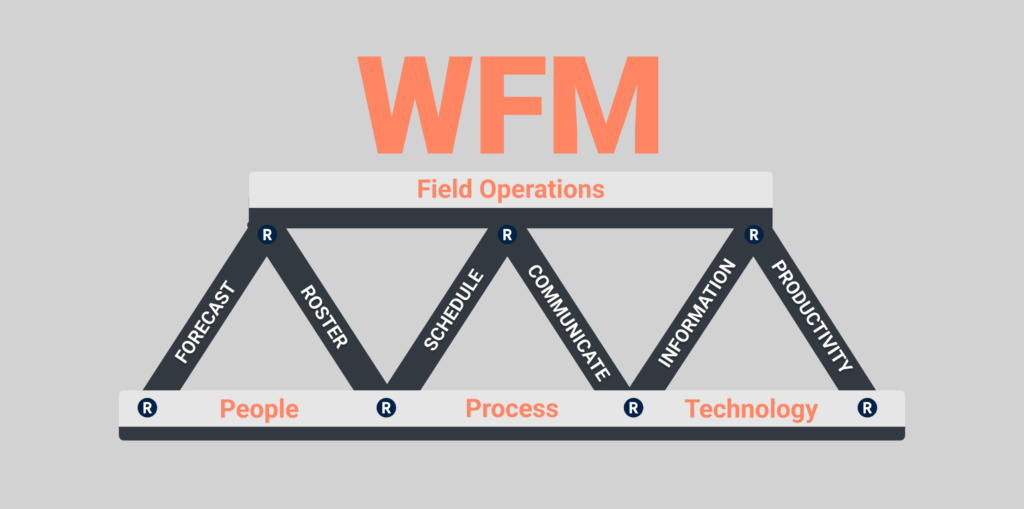
We have the six different pillars that support field effectiveness:
- Forecast
- Roster
- Schedule
- Communicate
- Information
- Productivity
They may happen in certain orders, but across the company, they’re fluid and they’re constantly cycling back and forth. Consider these all related and consider them as symbiotic. If Forecasting is weak or unstable or nonexistent, your Scheduling and Communications are probably going to take a lot of load and begin to crack. If you are doing all these things, but you don’t have the right processes or practice in place as a company to make sure they’re happening sustainably across every job, pretty soon you’re on a foundation of sand and they start to spread and kick out, and eventually you’ll have instability and collapse. These things are happening across the business. And so think of your different departments as contributing to these. What if your HR department was helping maintain the Roster and Certifications so your project and labor planning stakeholders can leverage those people better? And that’s how we get this concept as a whole. If you’re consistent across the 6 areas, you’ll be a highly successful contractor as a result.
Read more about the WFM Supporting Areas
Start today.
Adopting the RIVET Workforce Management Platform can have a huge impact on your field performance and profitability.
Start today.
Adopting the RIVET Workforce Management Platform can have a huge impact on your field performance and profitability.