Webinar Recap: Forecasting Supervision Before the Scramble



Everyone in construction is talking about the labor shortage. The harder problem sits one level up.
You can bring new people into the trade, but you can't manufacture a ten-year foreman — and that scarcity is quietly becoming the real ceiling on how fast a contractor can grow. That was the throughline of our recent live conversation with Kyle Wilson, General Field Superintendent at Poynter Sheet Metal (900-plus in the field), hosted by RIVET's Brian Witt. Watch the full conversation below, or read the short version of how Poynter turned supervision from a weekly scramble into a planned, protected advantage.
"I can't duplicate seat time. I can't accelerate five years of experience on a foreman. That seasoned veteran — you can't create that." — Kyle Wilson

From a private spreadsheet to a six-month horizon
When Kyle inherited the labor-coordinator seat, everything lived in one Excel file and a notebook that only he, the operations manager, and the safety director could see. Project managers were in the dark, and moving a single person meant a couple of phone calls and a string of personalized texts. On a good day he could see two to four weeks out — and, as he put it, four weeks was the generous side. It's exactly where most contractors still operate, and it isn't a discipline problem so much as a tooling one.
Today that picture is unrecognizable. Poynter now sequences supervision months in advance — back in February they were already staffing jobs that would start at the end of Q3, roughly nine months out, and they model prospective work on its own labor curve so a "90% lock" can be planned for without pretending it's certain. The shift wasn't willpower; it was finally having a tool built for the task.
"I'm living three to six months ahead. It feels like I'm planning out and making minor adjustments — rather than nonstop chaos, spinning my wheels day after day." — Kyle Wilson

Turning the busiest summer on record into an advantage
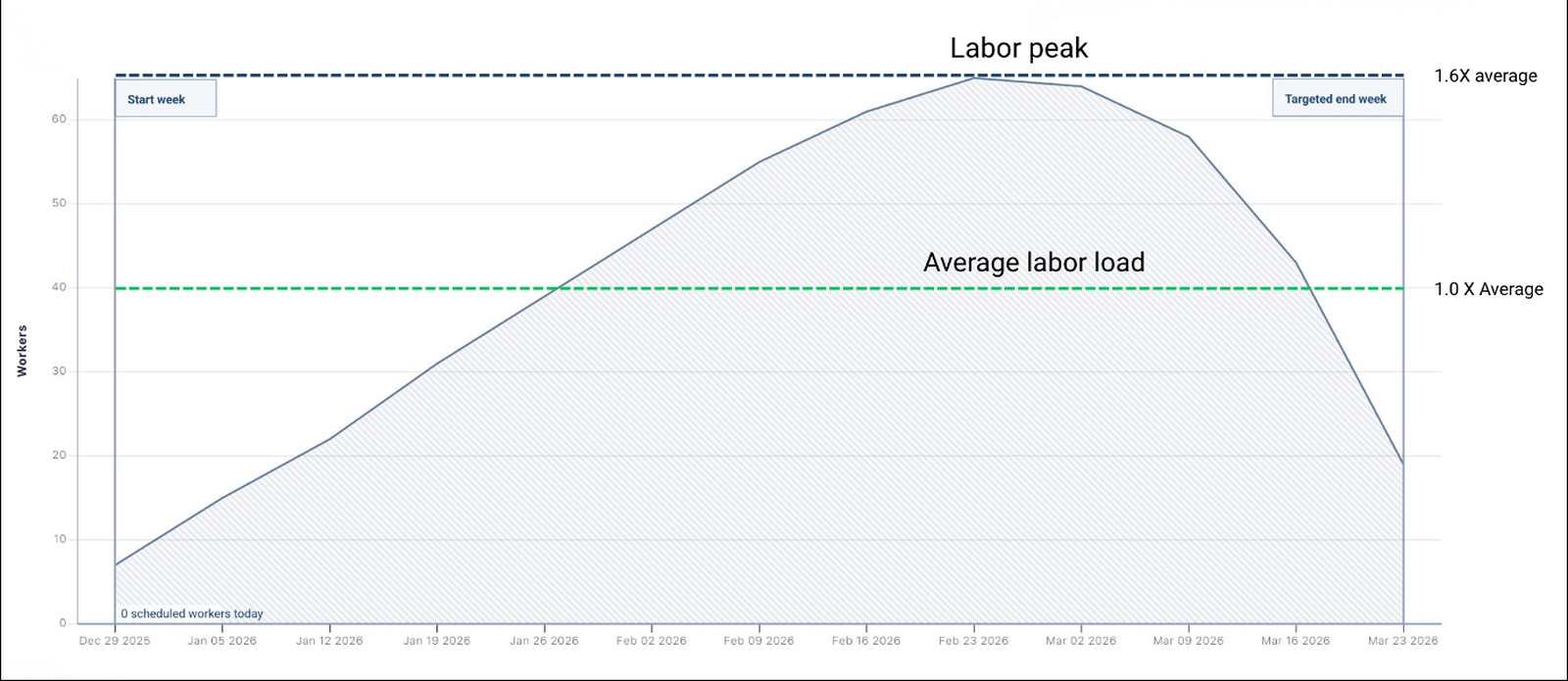
Poynter's peak runs from mid-May into early August, and this year, for the first time, they had it mapped in February and March — scaling labor curves, matching the right foreman to each job's size, and assigning supervision well before start dates. Kyle's goal was simple: absorb the chaos so nobody else felt it. No project manager getting the "you're behind" call; no scramble after Memorial Day.
It worked well enough that Poynter had the maneuverability to pick up extra scope competitors couldn't staff — the moment labor stops being a risk and starts being an advantage, and the opposite of the margin-eroding chaos most teams live in at peak. The same foresight reached the fab shop, one of the largest in the country at 300,000 lbs a week, which was quietly fabricating June work back in April.
Winning the last 20–40%
The close-out is where mechanical and electrical margin is usually won or lost. Left alone, the same crew rides a long job to the finish, complacency creeps in, and the margin fades — discovered too late on the next WIP. Poynter flips that on purpose by bringing in a fresh "closer" for the final stretch: new eyes, new energy, and none of the accumulated baggage of an 18-month project. A day or two of overlap keeps the knowledge, a couple of key players stay on for continuity, and the job gets put to bed.
"Like a closing pitcher. They come in, tighten things up, cut down the crew — and they don't have the baggage or the history of the job." — Kyle Wilson

Protecting — and growing — the people who run the work
Planning ahead also gives Poynter room to fight burnout and build its bench. Kyle is candid that the quieter form of burnout isn't overwork — it's doing the same task on the same floor for a year and a half until you stop looking for a better way. So they rotate crews and tasks deliberately and pair people to balance each other out. In parallel, a mentorship program of 10 to 15 people per cohort, led by a senior project manager, grows the next generation of foremen before they're needed rather than after. Underpinning all of it is a weekly operations meeting — VDC, safety, operations, project controls, Kyle, and the company president — that looks four to eight weeks out and builds teams together. It's the same cadence as the dreaded weekly labor meeting most contractors run, aimed in the opposite direction.

Case study: how Poynter turned labor data into a competitive edge
850+ field workers across five states. Live workforce maps in every bid. Manpower curves that justify change orders. See the full story behind the conversation — read the Poynter Sheet Metal case study →
The takeaway
Supervision is the constraint the whole industry is staring down, and you can't hire your way out of it. But as Poynter shows, you can plan around it, protect it, and grow it — and turn your scarcest resource into the reason customers call you when they're in a bind.
Keep going
- Read the case study: Poynter Sheet Metal — 850 field workers, 5 states, live workforce maps in every bid
- About Poynter: poyntersheetmetal.com
- See how it works: RIVET Forecasting
- More reading: Improve construction bids with labor forecasting · The hidden cost of labor planning chaos
Ready to ditch the chaos?
Join specialty contractors just like you who stopped accepting "that's just construction" as an excuse for losing money.