The Day of Reckoning: What 10,000+ MEP Projects Reveal About Labor Planning


Watch the session
RIVET teamed up with Wisconsin Chapter NECA for a virtual Labor Operations Master Class built for electrical contractors across the state. RIVET’s Brian Witt ran the hour solo after co-presenter Gary Fuchs got caught out by travel. The full session is above — here are the highlights.
Brian’s framing up front: there is usually two to eight percent of additional margin sitting out there on work you have already sold, and most of it is recoverable from the office rather than the field.
“There are a lot of things that we can actually do in the office with our labor planners that have huge, massive impacts to our productivity out on site.” — Brian Witt
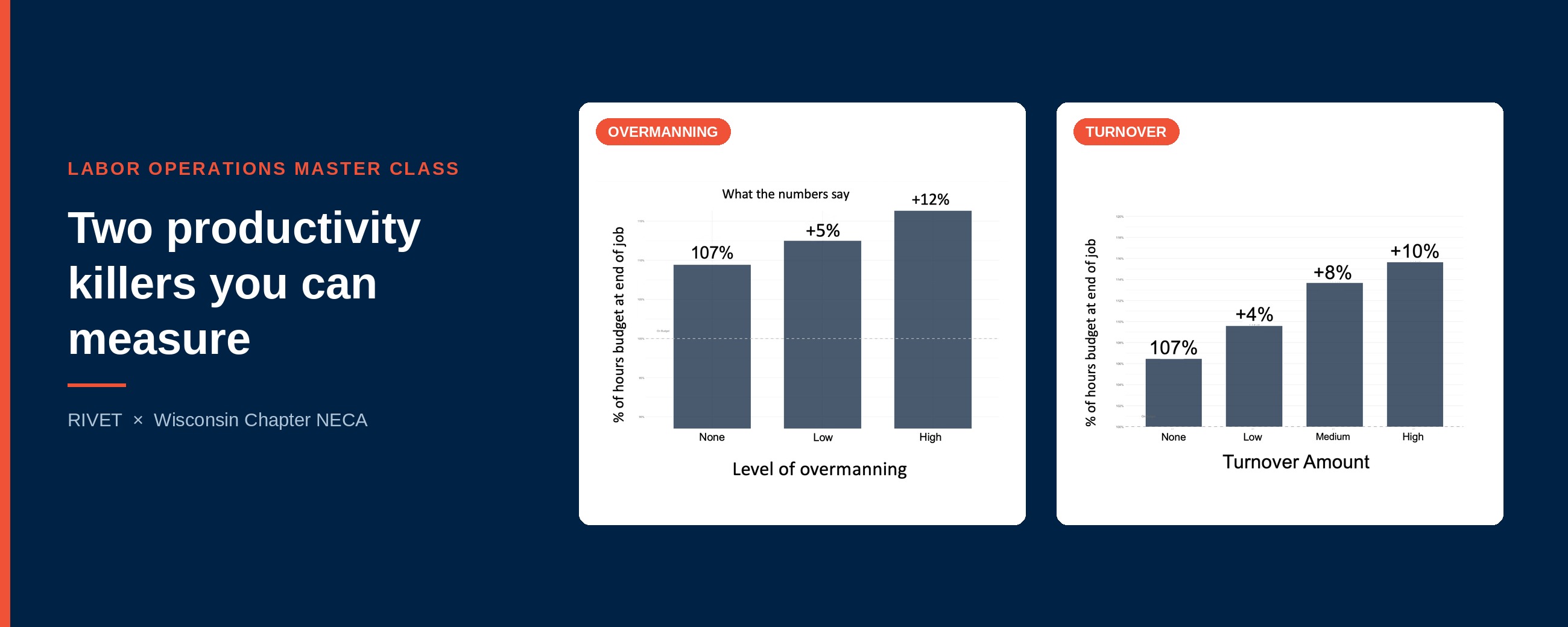
Two productivity killers you can measure
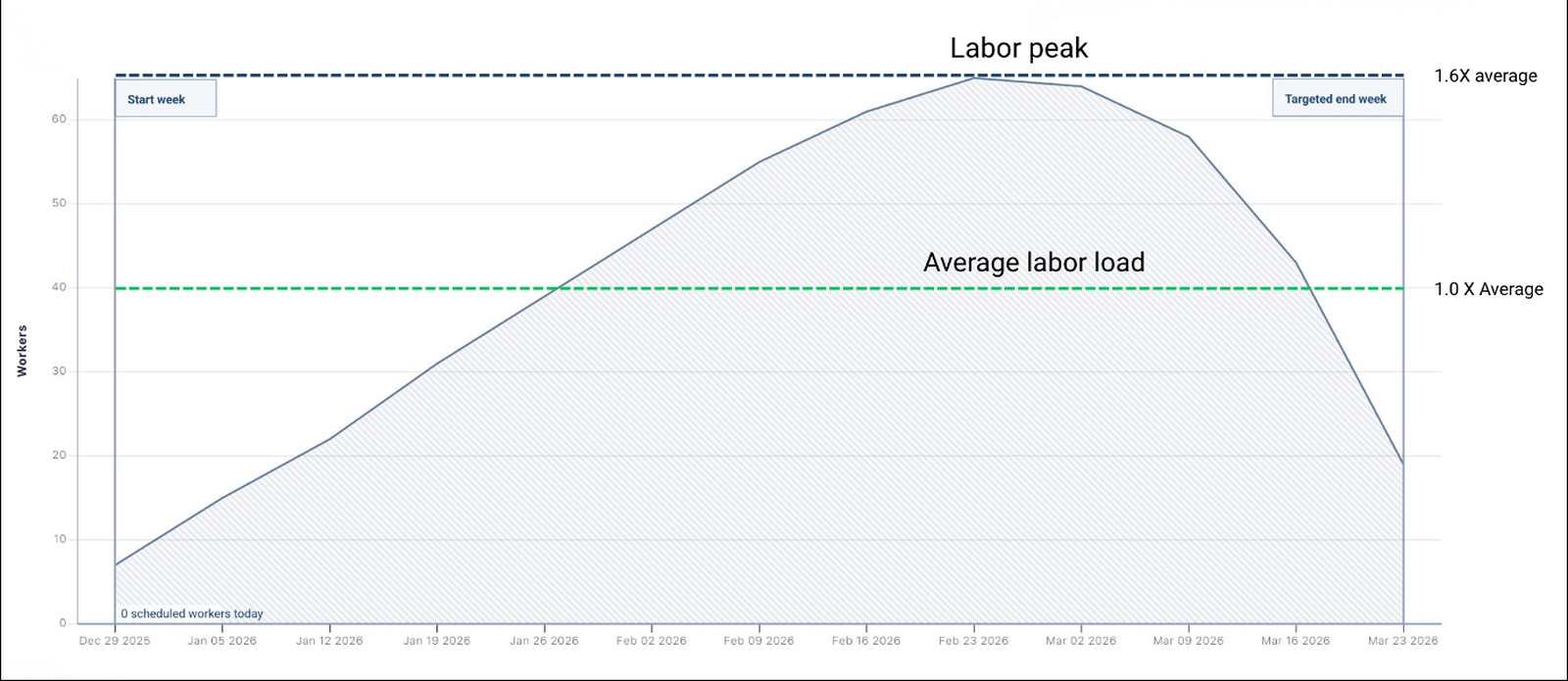
Dr. Awad Hanna — the UW–Madison professor whose ELECTRI- and MCAA-backed research underpins much of this — put the overmanning threshold at 1.6× a job’s average labor load. If your job averages 20 people, 32 is the line. Brian calls everything above it the danger zone.
“This is not Top Gun. I am not Maverick. We want to stay under the hard deck.” — Brian Witt
Across 10,000+ MEP projects, RIVET’s data adds resolution to the professor’s work:
- Overmanning — low: about 3% over the labor hours budget. High and sustained: 8% and above.
- Turnover — low: about 4% over. Medium to high: 8% to 10%.
Pull a foreman instead of a journey worker and turnover hurts more, because you take a bite out of everyone stacked under them — that’s loss of learning. And these numbers don’t stack: overmanning, turnover, supervision dilution, trade stacking, and overtime are symbiotic, arriving together and feeding each other. More on the full set in the research behind Productivity Risks and the five labor productivity killers.
The levels of labor planning
If you take one thing from the session, make it this barometer. Every level below is happening at real contractors right now.
- Start and end dates. You can see where jobs overlap.
- Financial averages. Job A is 10,000 hours. You still don’t know how many people, or when.
- A labor curve. Only 50–60% of jobs get one, usually the big ones, usually in their own spreadsheet — consolidated monthly, a month delayed, with pieces missing.
- Types of personnel. Not “15 at peak,” but how many journey workers and how many foremen, GFs, and supers.
- Real people with individual end dates — and which job they land on next.
Level five is hard to reach without a purpose-built tool. Level four is under its own pressure: Brian called 10-to-20-year field leadership “the endangered species of construction,” a problem we covered in forecasting supervision before the scramble.
The trap below level five: a person slotted under a job with no end date stays until somebody says otherwise — which in practice means until the job ends. That’s scheduling to the wall. Fine on the ramp-up. Expensive at peak.
The day of reckoning
Brian’s name for the most important moment on any job: the day you hit peak manpower. Not after you’ve been at peak — the moment you get there. That’s when the whole organization has to flip from an add-labor mindset to a get-labor-off mindset.
“It feels good as we ride at peak, but we’re walking the plank as we ride at peak.” — Brian Witt
Stay there and you either drift into the overmanning threshold or bleed out one person at a time. That bleed-out is margin fade — typically 1% to 8% for electrical contractors, concentrated in the last 25% of the job. You often don’t feel it, because you still made a good margin. There was just more meat on the bone.
The exit strategy recipe
Steps one and two will look familiar. It’s three and four where most organizations stop short.
- Foreman walks the site and builds the closeout task list with hours against each item.
- PM and general super re-walk it, layering in the logistics an electrician on the tools wouldn’t naturally account for.
- PM and super build the exit strategy. Take what the job can afford on ramp-down, update the forecast, and let the super name who comes off next and when. Even two or three names on the board beats none.
- Labor coordinator plans where those people go. Impossible without step three.
The cost of skipping it is concrete. In the weekly labor meeting, nobody volunteers people. Three crew members stay one or two weeks too long — roughly $24K gone on one job. Then they arrive late to the next one, which under-mobilizes and pays for it later as self-induced compression.
“It’s death by a thousand paper cuts.” — Brian Witt
More on protecting the back end: preserving profit on project ramp-downs.
The labor planning triangle
Three roles sit at the corners: the labor coordinator, the field leader, and the project leader. Two dynamics go wrong.
The project watcher. Field requests labor, the coordinator fills it, and the PM — accountable for a job where labor may be 40–60% of the margin — finds out at month-end WIP. Ask why the job busted and the PM says “that’s labor,” the field says “we did what we had to do,” and the coordinator says “I saved this thing.” Nobody’s lying. There was never a shared plan to measure against.
Squandering the superintendent. Open requests up to everyone and one person routes every request, every confirmation, and every individual notification. That person is usually one of your best operators, and they end up chasing phone numbers and certifications instead of looking ahead — the same trap behind field leaders losing their day to admin and spreadsheets buckling under work they were never built for.
What works is the bottom line of that triangle: field and project leadership align on labor needs before they reach the coordinator. And give the field visibility into their own hours budget — telling a foreman he busted a number he was never shown is a planning failure, not a field failure.
Find labor variance early, or don’t bother
RIVET asked roughly 50 MEP executives, most with 20–30+ years in, what a schedule compression claim actually yields by phase:
- First 33% of the job: 70–100 cents on the dollar
- Middle 33%: 30–70 cents
- Last 33%: 10–30 cents
The only number anyone argued about was the last one — and nobody argued the other direction. Finding it earlier always pays more.
Catching it early takes three lines on one chart: the forecast, the schedule (real people assigned), and the actuals (hours from payroll). Two weeks of variance warrants a claim regardless of job size, and the lines tell you whose it is:
- Schedule below forecast, actuals low too → internal compression. You failed to mobilize.
- Schedule tracking forecast, actuals well below → external compression. Work blocked or schedule slippage — a claim with evidence behind it.
Overwrite a spreadsheet cell and the prior forecast is gone, along with your ability to show a GC when compression started. A lot of owners count on contractors not bringing hard data. Bring it. (Forecast versioning exists for this.)
It’s not about the plan
Brian bookended the hour with Eisenhower: plans are useless, but planning is indispensable. Nobody expects the man-loaded schedule to survive contact with the job. The point is the culture of planning — someone knows who’s coming off Job A on the 14th, the PM sees the same picture as the super, and peak triggers an exit strategy instead of a victory lap. It’s the clearest case we know for finishing one job strong to set up the next.
“It’s dollars straight to the bottom line, and it’s sanity for our people.” — Brian Witt
Thank you, Wisconsin
Thanks to Wisconsin Chapter NECA for hosting and to their members who joined. The chapter runs a deep bench of management education and events across its Fox Valley, Indianhead, Janesville-Beloit, Kenosha, Madison, Racine, Northeastern, and Wisconsin Valley divisions. RIVET has a lot of customers and good friends in Wisconsin, and it shows.
Headed to Las Vegas? We’re running the Labor Operations Master Class live at NECA 2026, October 4–7 at Mandalay Bay — catch it at Booth #1725 on October 6, or join our breakout, Look-Aheads and Project Planning: Closing the Loop.
See it on your own jobs
The forecast, the schedule, and the actuals on a single view, with version history behind them, is what turns this into a repeatable habit — and that’s what RIVET’s labor control center is built to do. Schedule a demo, or just talk to someone about what this looks like at your company.
Ready to ditch the chaos?
Join specialty contractors just like you who stopped accepting "that's just construction" as an excuse for losing money.