Margin Fade Starts Long Before You Feel It


Watch the recording
The full session is available on demand above, or watch it on YouTube.
Most contractors know the feeling. The job closes out, the numbers come in, and the margin you bid isn’t the margin you got. Nobody can point to the moment it went wrong.
That gap has a name — margin fade — and in our recent webinar, Combatting Margin Fade, two senior operations leaders made the case that it’s almost never a mystery. It’s a visibility problem, and it shows up on a schedule you can predict.
RIVET’s Brian Witt was joined by:
- Shawn Kast, VP of Operations at Tessier’s (an APi Group company), who came up through the field on the sheet metal side.
- Gary Fuchs, now with RIVET, who spent 40+ years on the electrical side, finishing his career as VP of Operations at Westphal & Company as it grew from roughly 400 electricians to nearly 1,000.
Margin fade is not margin loss
Start with the distinction, because the two get used interchangeably and they mean very different things.
“Margin fade is really the fade of profit based off of your estimated margin that you booked the job at. If you’re losing any margin off the estimated margin, that would be considered margin fade.” — Shawn Kast
Margin loss is terminal. You’ve burned every ounce of margin and you’re lucky to cover overhead. Margin fade is the delta — the distance between the profit you planned on and the profit you got. It’s survivable, it’s measurable, and unlike margin loss, it’s something you can still act on while the job is running. That’s the whole reason it’s worth chasing: the profit is still there to preserve.
The causes are boring, which is exactly the problem
Ask what causes margin fade and you get a short, unglamorous list: schedule compression, overmanning, leaving crews on site too long, and no real forecast to run the job against. They are the same forces behind the rest of the labor productivity killers we see across electrical and mechanical contractors. Gary put his finger on the one underneath all of them:
“Not having visibility into what your labor plan really is is really a key culprit.” — Gary Fuchs
And the most common version of that, in his experience, is deceptively small: assigning a person to a job without an exit date. Not the wrong person. Not too many people. Just no answer to the question of when they leave.
Scheduling to the wall
That single omission produces a pattern the group called scheduling to the wall — the same failure mode we broke down in scheduling to the wall vs. proactive labor forecasting.
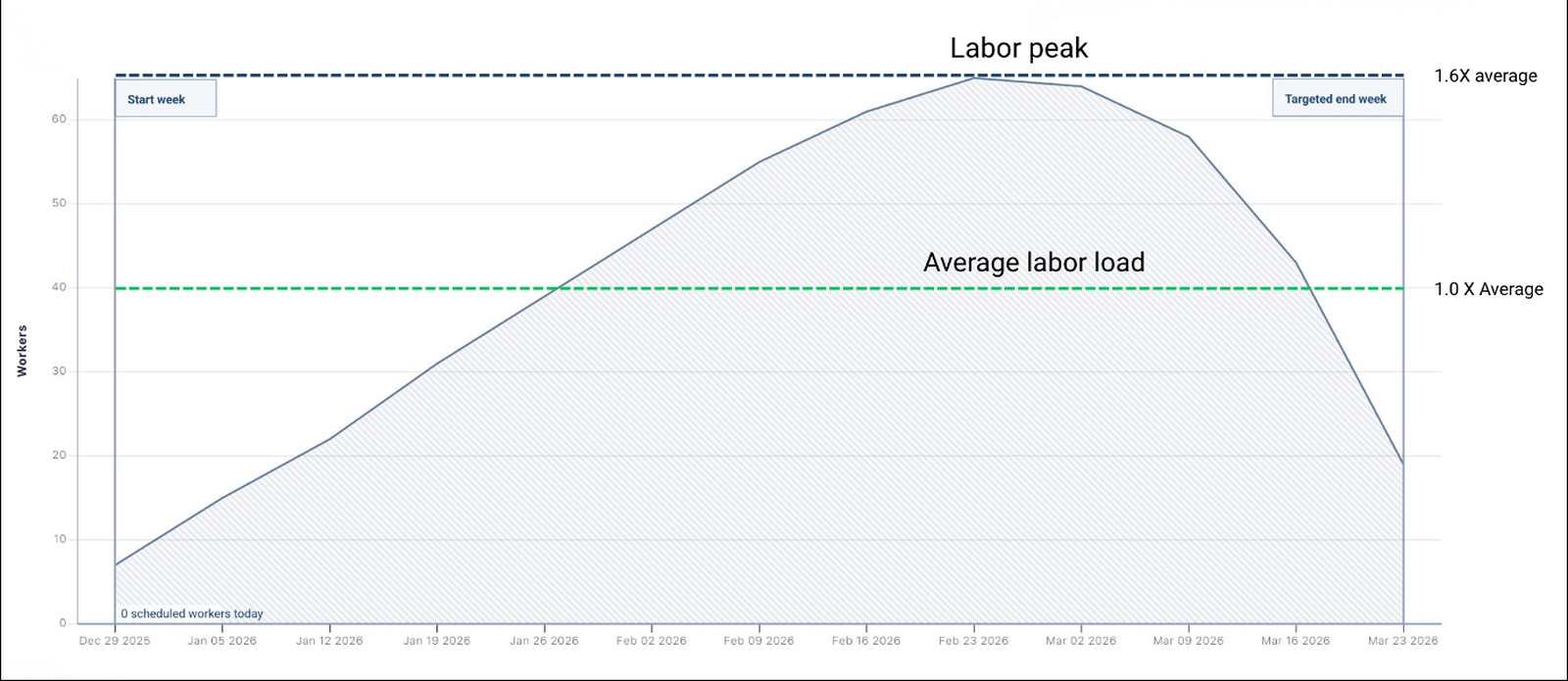
Now picture how people actually get assigned to that job. Rosie starts in week 3, Tim in week 5, Jane in week 8. Each one gets a start date. None of them gets an end date.
So the default end date becomes the end of the job. Instead of tapering, actual manpower runs flat into a wall at closeout. If you run labor on a whiteboard or a spreadsheet with names listed under each job and no end dates beside them, this is what’s happening whether you can see it or not.
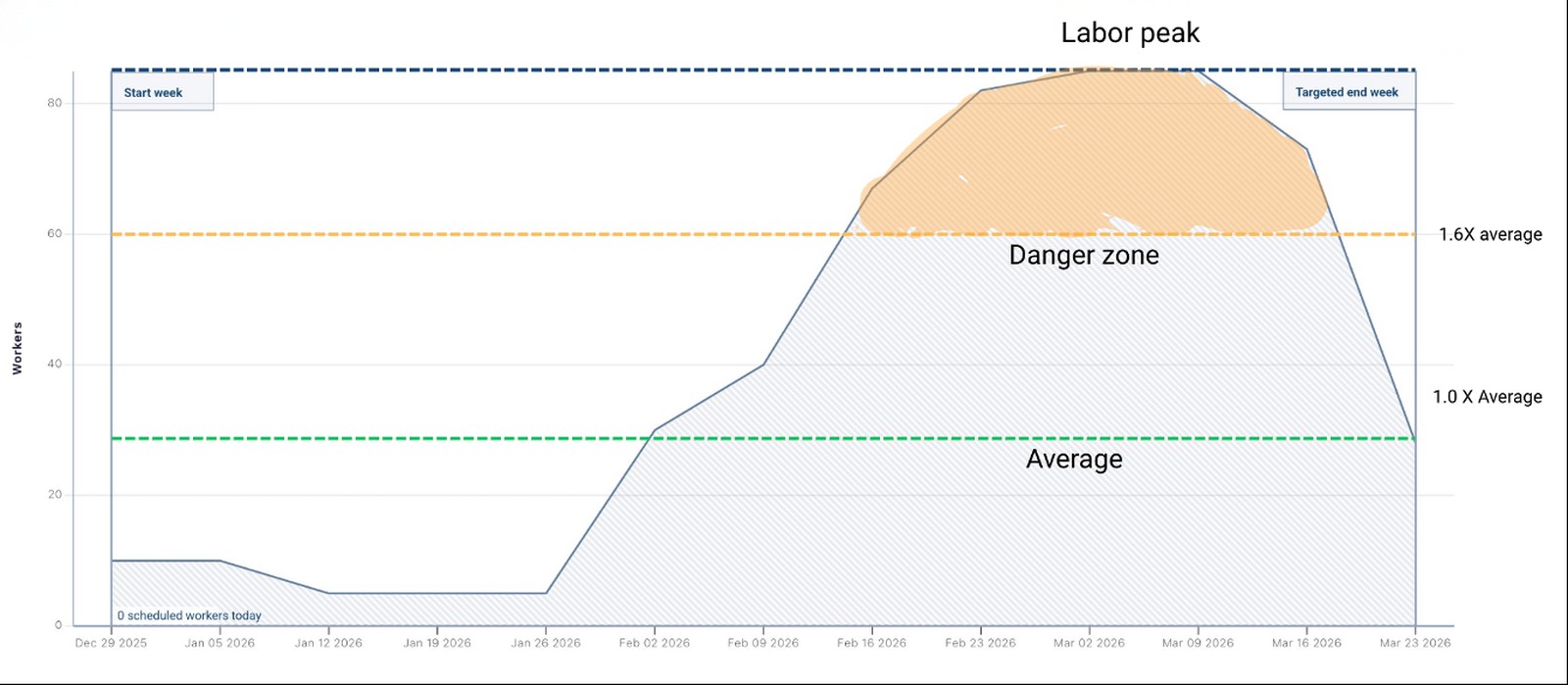
In practice nobody stays to the literal last day. People come off reactively, a few at a time, when a field leader offers them up in the weekly labor meeting.
“Usually when they leave the site it’s because the field leader is the one who determines, okay, I can now part with this individual — which is typically too late.” — Gary Fuchs
The damage lands in what we call the margin fade zone: roughly the last 20 to 30% of the job. Three people staying one or two weeks past their usefulness isn’t a rounding error. It’s pure loss, booked at the worst possible time.
And it compounds. As Gary put it, the forecast is going down while the labor level stays flat: “It’s twenty-four thousand this week. It’s probably closer to seventy thousand next week.”
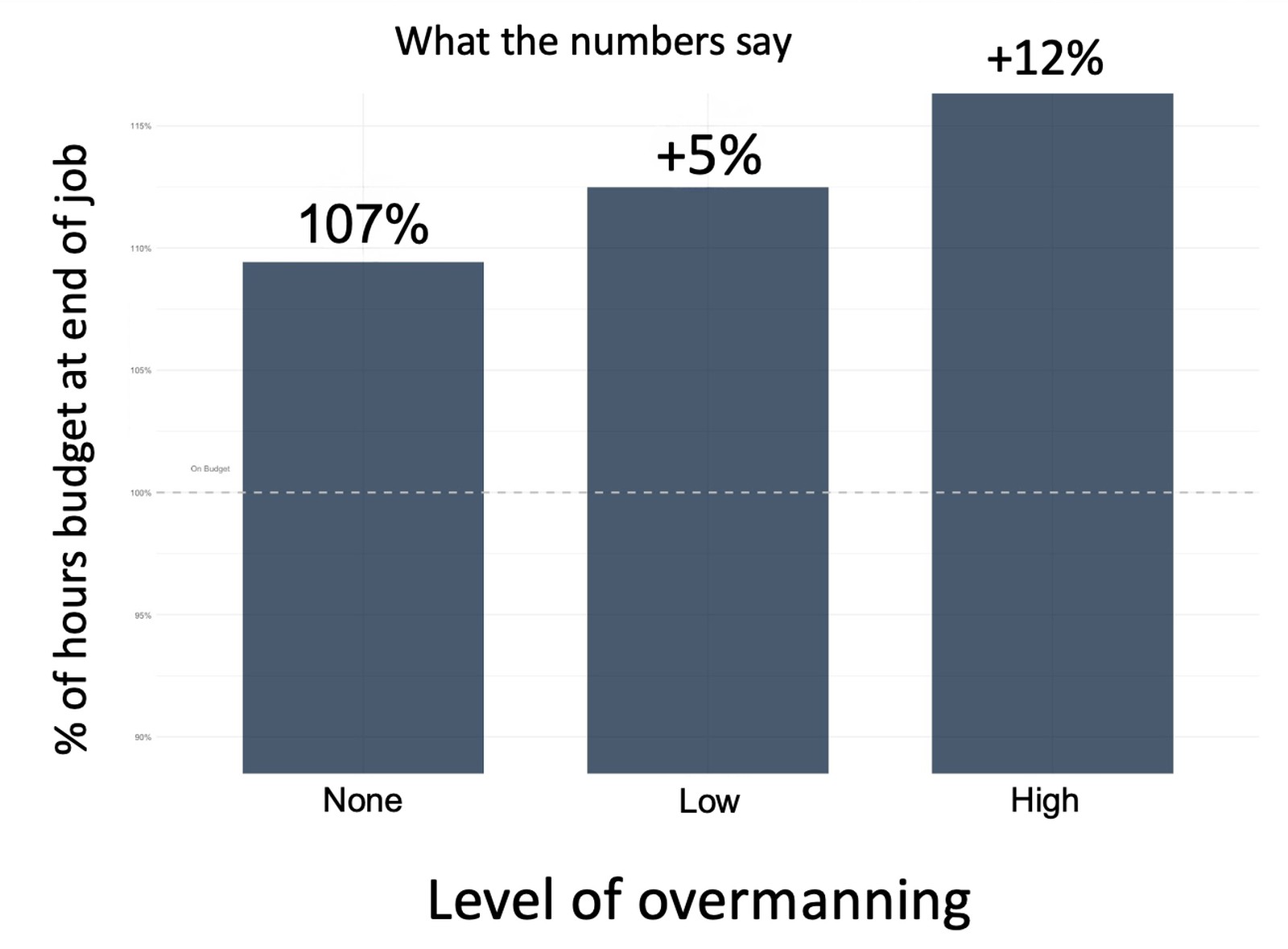
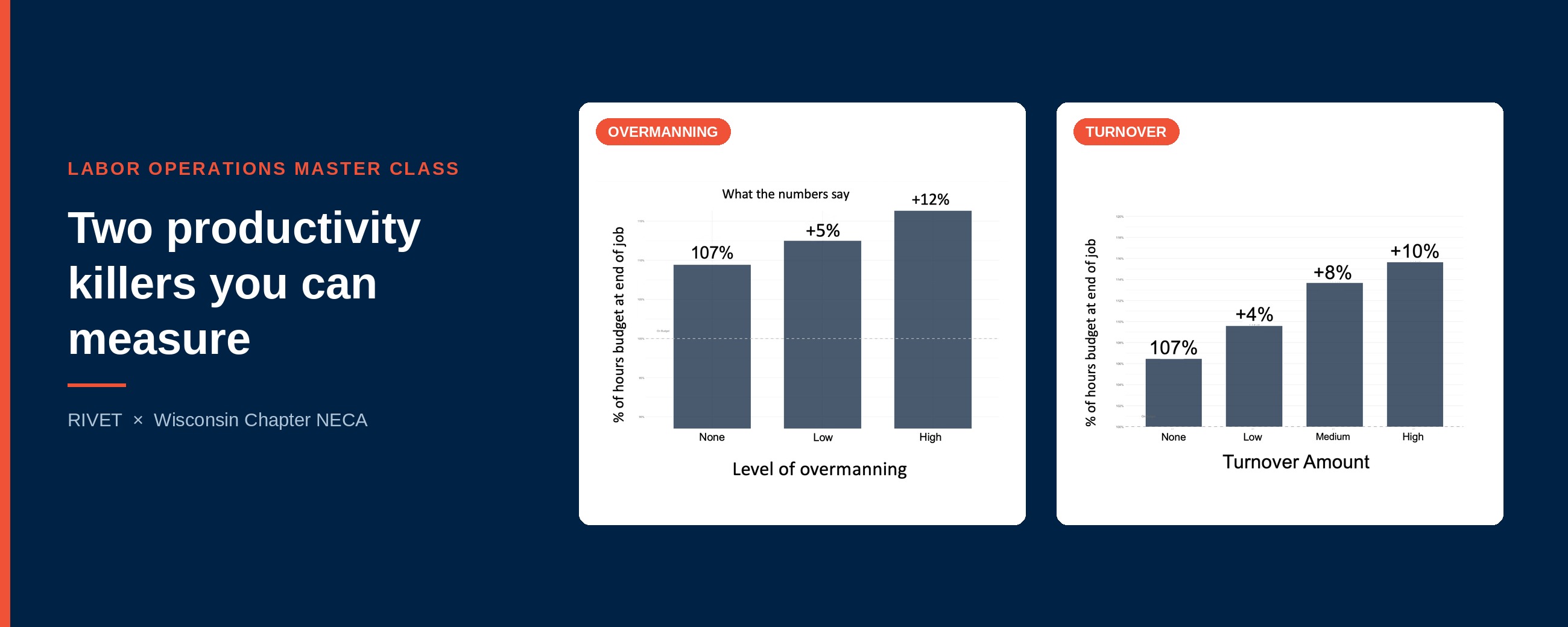
Those thresholds aren’t guesses — they come out of the research behind Productivity Risks, which digs into how overmanning, supervision dilution, and turnover each erode a job.
It doesn’t stay on one job
This is the part that turns a project problem into a company problem. People held too long on Job 1 show up late to Job 2. Job 2 starts behind, so it overmans to catch up, blows past its planned peak, and hands the same problem to Job 3. It is the clearest argument we know for finishing one job strong to set up the next one.
“This is the way we create our own labor shortage. You can hire your way out of this situation, and it gets very expensive very fast.” — Gary Fuchs
That is worth sitting with. Most contractors treat the labor shortage as a market condition. A meaningful share of it is self-created.
Shawn added the part that stings later: showing up late costs you leverage. When the GC creates a delay and you need to make a claim, the fact that you started behind becomes their argument, not yours.
Why finding it early is worth real money
We put a question to 40–50 construction executives — MEP contractors with 10 to 20+ years in, running companies from hundreds to thousands in the field — about claim recovery by project phase. Here is what they told us:
- First third of the job: close to 100 cents on the dollar
- Middle third: roughly 30–70 cents
- Last third: roughly 10–30 cents
What’s telling is where the executives disagreed. They argued hard about the last-third number — some said 30–50 cents, some said zero to ten. Nobody argued the other direction. No one disputed that finding it earlier gets you paid more.
Gary’s explanation is blunt: “When you’re in the red, the project’s usually out of money anyway.” And submitting isn’t the finish line — a claim that drags on until the project is in the red still ends up in the same place. Getting ahead of it starts earlier than most teams think, all the way back at how you forecast labor into the bid.
The forecast has to be alive
Asked how many weeks of variance they’ll tolerate before acting, both men answered instantly and identically: two weeks. That answer sets the cadence for everything else. If two weeks of drift is your trigger, a forecast updated monthly is already too slow.
“The problem with forecasts is people make an initial forecast and then they walk away from it and never run the project by the forecast either. A forecast is living. It’s living weekly to me.” — Shawn Kast
Running the job by the plan instead of around it is its own discipline — we covered the mechanics in schedule to your forecast, and forecast versioning exists precisely so a living forecast still leaves an audit trail.
Gary’s addition: when it’s a single source of truth updated in real time, you stop waiting for the weekly cadence at all. You see a trend drifting midweek and you act midweek.
Why you need three lines, not two
Comparing forecast to actuals tells you that there’s a variance. It doesn’t tell you whose it is. You need three data points on the same picture:
- The forecast — what the project stakeholder projected to finance and leadership
- The schedule — the actual named people the field assigned to the job
- The actuals — hours genuinely burned, integrated from the ERP
Scheduled 10 people but billing hours for more? You understaffed against the plan and you’re covering with overtime — internal compression, your own doing. Scheduled the right number per the plan and the actual hours are lower? Work is being blocked — that’s external, and that’s a claim. Same variance on the chart. Completely different conversation with the GC. Putting all three on one view is what RIVET’s forecasting is built to do.
Exit strategy: the discipline that pays
Both men landed on exit strategy as the highest-leverage habit, and both start it before peak — Shawn around 60–65% complete, Gary closer to 75% on the electrical side.
Gary’s example is worth the whole hour. A roughly 100,000-hour project, about 70,000 hours spent, twelve foremen on site. Each foreman went out, built his own punch list, and assigned hours to it. Collectively they came back with 18,000 more man-hours — finishing 12,000 hours under budget. The same list went to a group of more experienced people. They came back with 28,000.
So the team gave the foremen the 28,000-hour number and built each of them a de-manning schedule: in two weeks you lose two people, in four weeks two more. Everyone left the meeting confident. Two weeks later, when the first two came off:
“I can’t. It’s human nature. They’ve worked this entire job, they’ve got it to a point where they’re comfortable, and they don’t want to put themselves in a position where they’re going to fail.” — Gary Fuchs
They held the plan anyway. Kept peeling people off. Conformed to the curve on the back end. The job finished under the labor budget — and without it, Gary figures they’d have run about 10% over.
His rule going forward: if a job is big enough to have a labor forecast, it’s big enough to have an exit strategy.
There’s a productivity dividend hiding in that discipline too. Every extra body cycling through a job late costs you the loss of learning that quietly destroys margin.
The cultural shift Shawn described is the real payoff. When the plan is visible to everyone, the pressure reverses:
“Pretty soon our field leaders are pushing at us: hey, we’ve got to drop now. The plan says this. It shows me dropping two.” — Shawn Kast
That’s a different company than one where a PM has to beg for five people to come off a job that’s already over.
Hide the budget from the field and you’ve already lost
Asked what happens when field leadership can’t see the labor hours budget, Shawn didn’t need long:
“I go in the office and say, where am I sitting on hours? Well, you don’t need to know that. Then you come to the end of the job and they say, well, it looks terrible, you went over hours. No visibility equals instant margin erosion.” — Shawn Kast
Gary’s read: without the curve, the only thing a field leader can do is whatever it takes to get it built. No accountability, no responsibility, no chance. Shared visibility between the office and the field is the whole premise of collaborative workforce management.
He also pushed back on the old-school instinct to staff nine where the job calls for ten. That “savings” creates the dip on the front end of the curve, and you pay it back with overtime and overmanning in the last 30% — with interest.
What it’s actually worth
“Why would you leave 4 to 6% margin on the table?” — Shawn Kast
Gary framed the upside at the company level: best-in-class used to be 4 or 5%. Plan proactively across every project and you can add two, three, four points — straight to the bottom line, not saved but earned. At a $100M contractor, that’s real money.
Then there’s the second-order effect. Getting people off Job 1 on time staffs Job 2 earlier, which lowers Job 2’s peak, which means more jobs with the same workforce in a market where hiring bonuses are the going rate for skilled trades.
“For years we looked at productivity as trying to get the field people to work harder, with better tools. When the reality is we should start looking in the mirror at the decisions we’re making when we’re managing this manpower, and what kind of effect we’re having on the productivity of our company.” — Gary Fuchs
The takeaway
Margin fade isn’t a mystery and it isn’t bad luck. It’s the predictable result of assigning people to jobs without planning how they leave, and then not looking at the curve often enough to notice.
The fix is unglamorous: give every assignment an exit date, treat the forecast as a living document, put the plan in front of the whole team, and act on two weeks of variance instead of twelve.
Or, as Gary put it: “The visibility is worth its weight in gold.”
Keep reading
- Scheduling to the wall vs. proactive labor forecasting
- Schedule compression happens, but it doesn’t have to tank your margins
- The research behind Productivity Risks
- The hidden margin killer: how loss of learning quietly destroys your margin
- Webinar recap: forecasting supervision before the scramble
See it on your own jobs
RIVET is a real-time labor control center built for MEP contractors — forecast, schedule, and actuals on a single view, so the variance shows up while you can still do something about it. Our productivity insights flag the jobs drifting before they hit the margin fade zone.
Schedule a demo, or just talk to someone about what this looks like at your company. No tool required to start the conversation.
Ready to ditch the chaos?
Join specialty contractors just like you who stopped accepting "that's just construction" as an excuse for losing money.