
Compare
RIVET vs. Bridgit: an honest comparison for specialty contractors
Both are construction workforce planning platforms. They were built for different jobs. Here's who each one is for, and what contractors running 90 to 1,500+ field workers say about RIVET.
The short answer
Bridgit grew up planning general contractors' salaried project teams: PMs, project engineers and superintendents spread across many projects. RIVET was built for self-performing electrical, mechanical and plumbing contractors, to plan hundreds of field craft workers against labor curves, synced to the construction ERP they already run. If you're a GC staffing project teams, Bridgit is a strong option. If you're an MEP contractor planning field labor, the contractors below are the best evidence we can offer.
Who each is built for
Inside the platform
Built for how MEP contractors run work
The views electrical and mechanical contractors use every day, from the office to the job site.
Productivity risks
Catch overmanning and thin supervision mid-job
RIVET compares every active job's labor plan with who is actually on site. It flags jobs at risk of overmanning, diluted supervision or crew turnover, and shows the hours at stake while there's still time to act.
Tessiers Mechanical flags 85–90% of schedule compression events early.
Learn more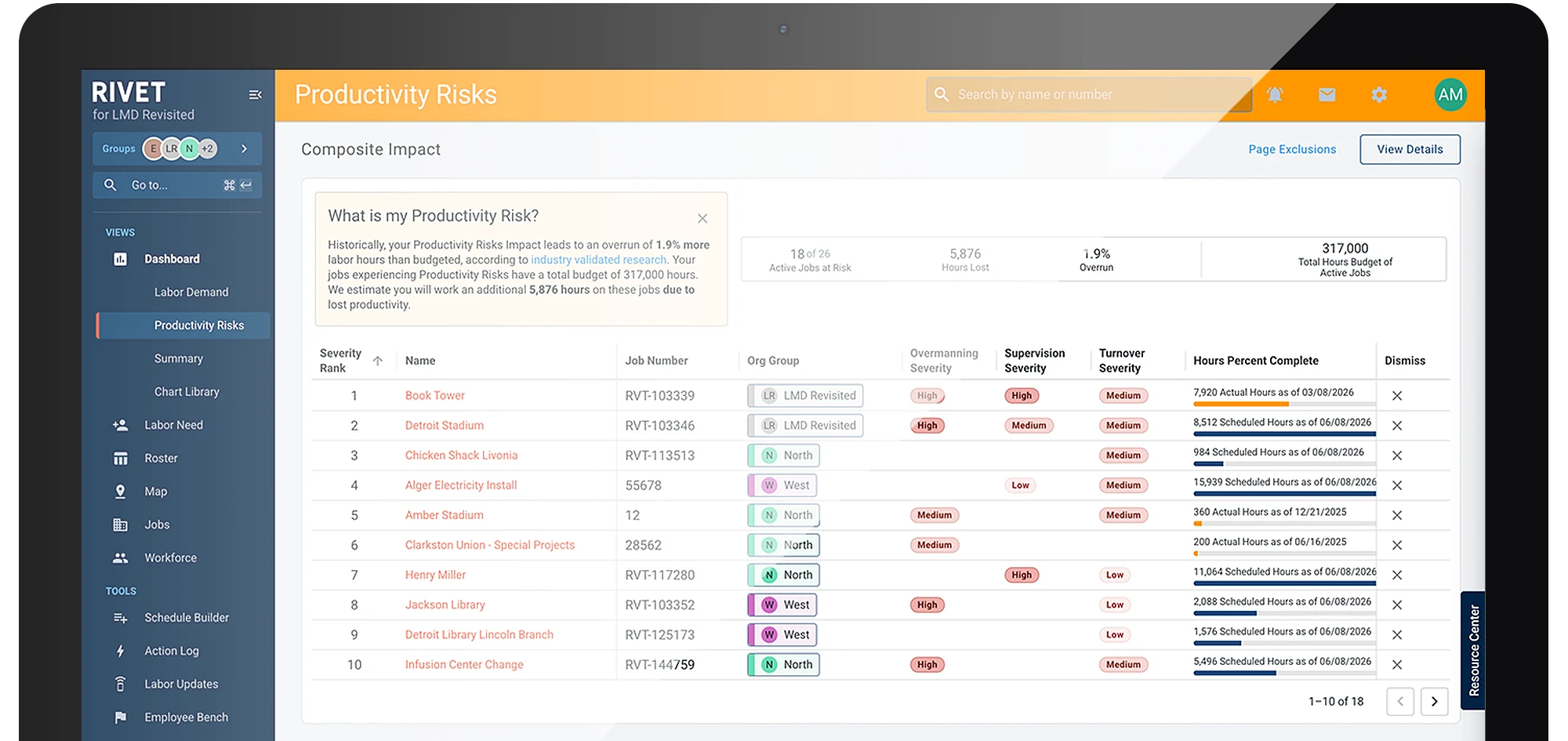
Field communication
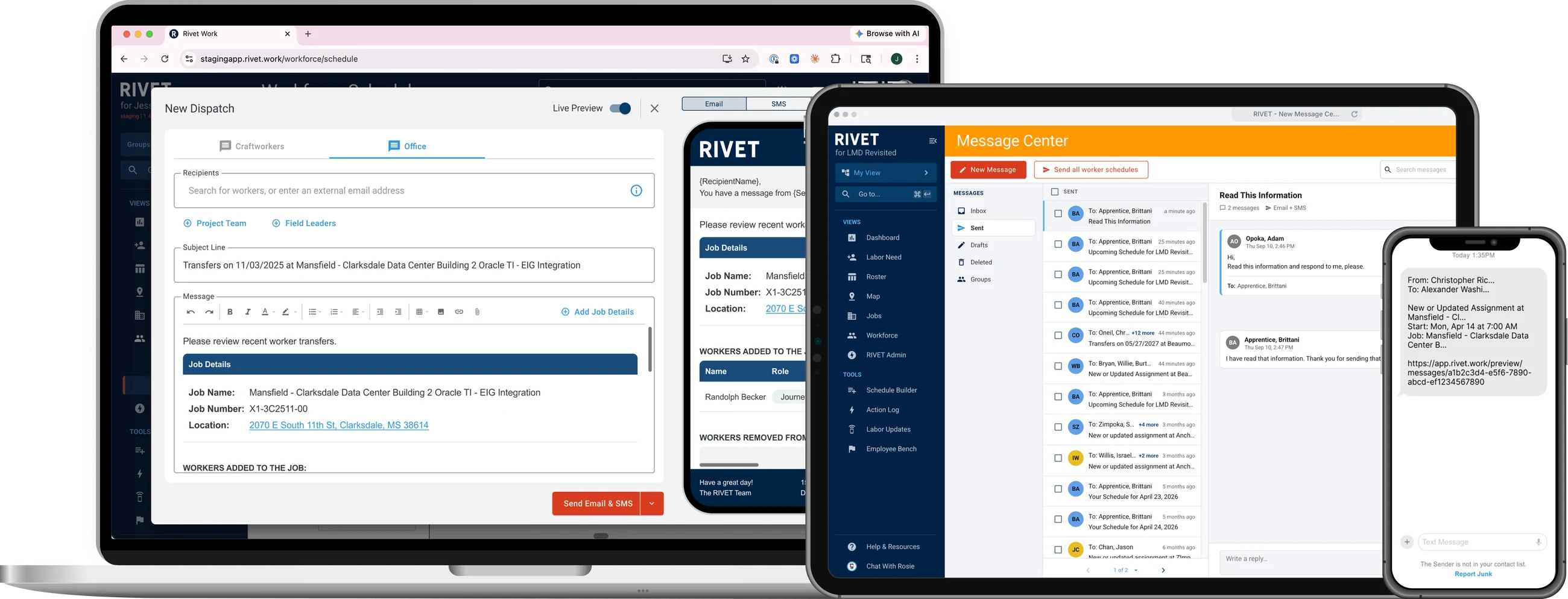
One click from the plan to the field
Motor City Electric moves 50+ workers between jobs in minutes.
See field communication →Send assignments and schedule changes to one worker or every crew at once, straight from the schedule. No phone tree, no group texts.
- ✓Compose once in the Dispatch composer, with a live email and text preview
- ✓Every thread, delivery and read receipt lands in the Message Center
- ✓Crews get the assignment, and a link to view it, on their phones
Labor forecasting
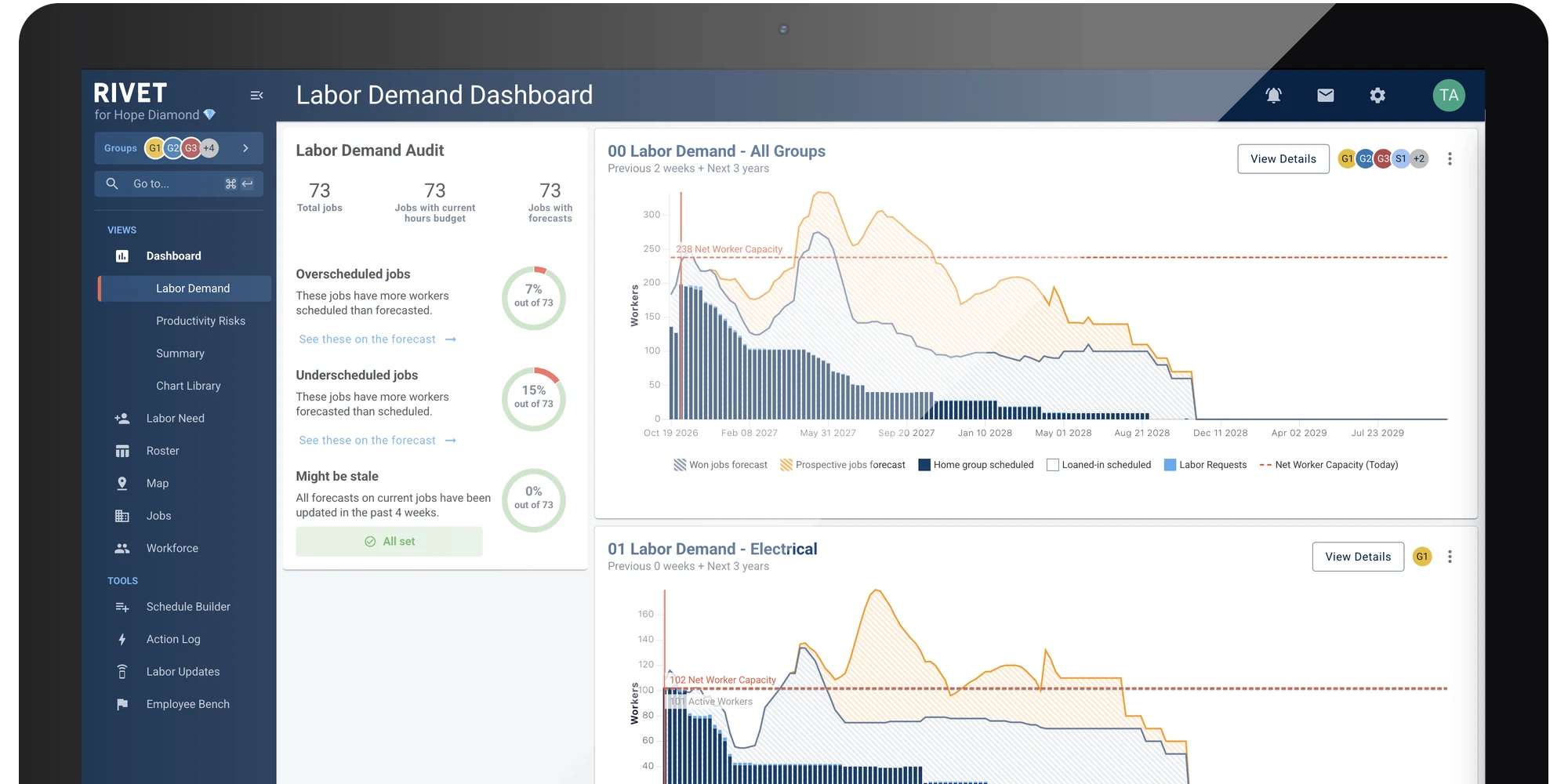
See peaks and gaps years before they hit
Labor Demand stacks awarded and pursuit work against your real capacity, by division and trade. Bid the work you can staff and hire ahead of the peak.
2–3 years
of labor visibility at Motor City Electric
Awarded + pursuit
work on one forecast
Trade labor curves
from national trade associations
Crews and rosters
Every crew, every job, one board
Crew makeup per job
Foremen, journeymen and apprentices, with today's blended rate
Moves before idle time
Workers flagged for transfer before anyone sits
Certifications as you schedule
Alerts before cards, trainings and badges expire
Poynter Sheet Metal runs 850 field workers across five states on RIVET.
See the Roster Board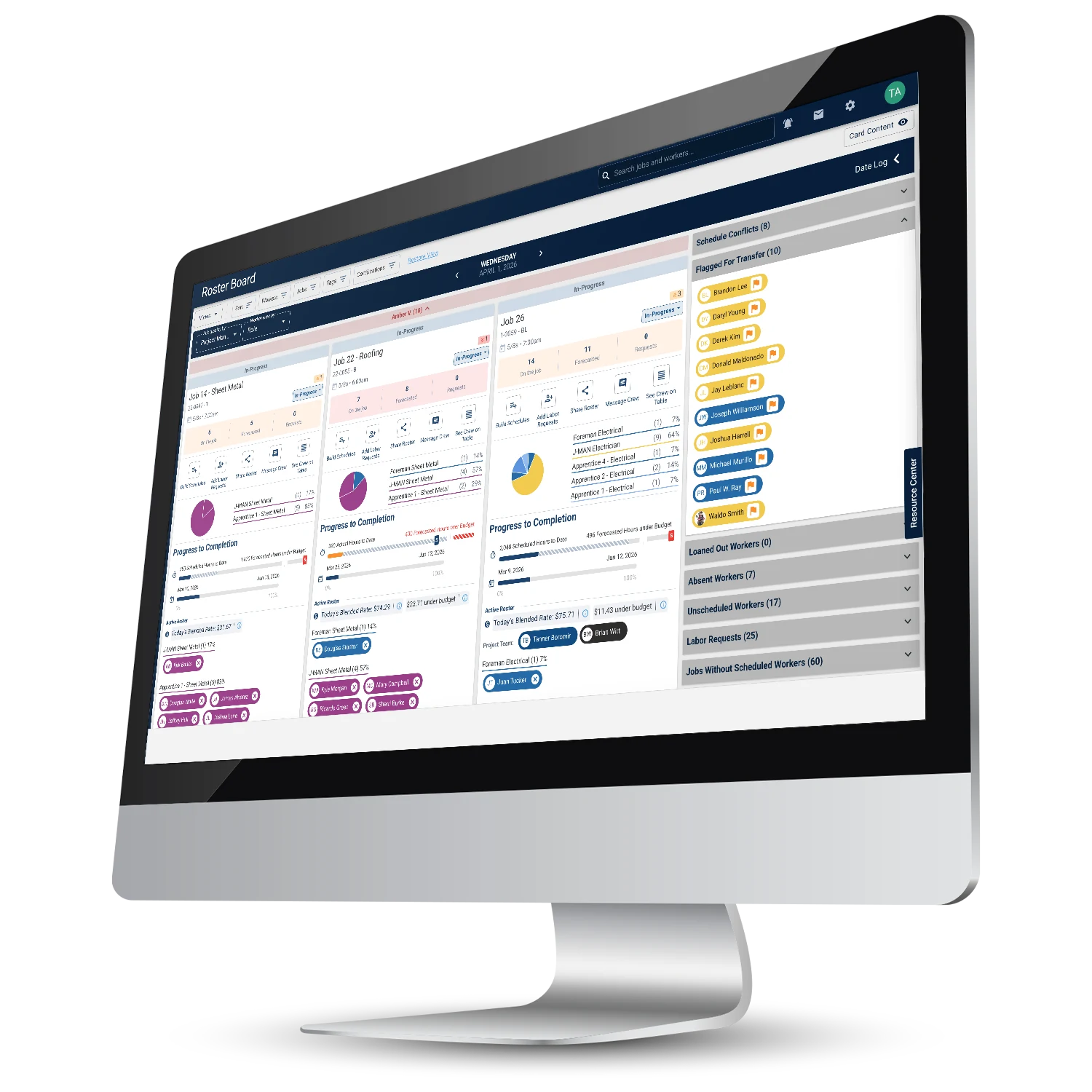
What MEP contractors should know about RIVET
If you're evaluating workforce planning platforms, these are the questions we hear most. Each answer comes from a contractor running RIVET today.
Company size
From about 90 field workers to more than 1,500, in electrical, mechanical and sheet metal.
Ace Electric grew from 250 to 1,300+ workers on RIVET. Motor City Electric manages 600 to 800 electricians. Poynter Sheet Metal runs 850 across five states. Harrell-Fish runs 600+ mechanical and plumbing workers.
Planning horizon
Day-to-day crew scheduling and portfolio forecasting of awarded and pursuit work, weeks to years out, with scenario planning.
Motor City Electric extended labor planning from 3 months to 2–3 years. Tessiers sees three years across its portfolio. Interstate Electric plans a full year out across six states.
Your ERP
Direct connections to the systems MEP contractors run, plus HR systems and a documented REST API.
Viewpoint Vista (certified on Trimble Marketplace), Viewpoint Spectrum, Foundation, Access COINS, CMiC, Sage 300 CRE, Sage Intacct, Deltek ComputerEase, Jonas, Plexxis, ADP and BambooHR. See all integrations
Implementation and support
A dedicated implementation manager, a data services team, live in-app chat and an assigned account manager.
CarolinaPower was up and running in two weeks, after three earlier platform attempts in a single year. Support requests get a response within two business hours.
In the field
RIVET runs on phone, iPad and desktop, so office and field teams see the same plan.
Duro Electric's team works with real-time visibility across browser, iPad and phone.
Certifications
Automatic alerts before certifications, trainings and badge access expire, tied to who you schedule.
Mid-City Electric centralized every field certification for 750 workers and eliminated duplicate credentialing.
Beyond the U.S.
RIVET contractors operate in Canada as well as across the United States.
DILFO Mechanical in Ottawa, Ontario schedules 200+ workers in minutes on RIVET, synced with Spectrum.
Every example comes from a published RIVET case study. Product details for any vendor change over time, so ask each one for current references in your trade.
What MEP contractors say
100%
PM adoption, compared with 15% on their previous software
Interstate Electric · 750+ employees, 6 states
$500K+
in annual margin exposure protected by flagging compression early
Tessiers Mechanical
50+
workers moved between jobs in minutes, with planning extended to 2–3 years
Motor City Electric · 600–800 electricians
200+
workers scheduled in minutes, with no double entry through the Spectrum integration
DILFO Mechanical · Ottawa, Ontario
850
field workers on one platform across five states, with labor curves used to prove compression on change orders
Poynter Sheet Metal
1,300+
workers on one live roster, up from 250
Ace Electric
Questions to ask any workforce planning vendor
- How many contractors in my trade, at my size, can I call as references?
- Does it connect directly to my ERP, or will we be exporting spreadsheets?
- Does forecasting use trade labor curves, or just headcount?
- Who implements it, and how long until my PMs are using it?
- When something breaks, who answers, and how fast?
Frequently asked questions
What's the difference between RIVET and Bridgit?
Bridgit primarily plans general contractors' professional staff using HRIS and CRM data. RIVET plans MEP field craft labor using your construction ERP, with trade labor curves for forecasting.
What size contractors use RIVET?
RIVET customers range from about 90 field workers to 1,500+, including Ace Electric, Motor City Electric, ERMCO and Poynter Sheet Metal.
Does RIVET work for contractors in Canada?
Yes. One great example is, DILFO Mechanical in Ottawa, Ontario runs RIVET connected to Viewpoint Spectrum.
Does RIVET integrate with Vista, Spectrum, Foundation and COINS?
Yes, directly. RIVET's Viewpoint Vista integration is certified on Trimble Marketplace.
Can field leaders use RIVET from their phones?
Yes. RIVET works on phone, iPad and desktop, so field leaders can see rosters, request labor and message crews from the job site.
How long does implementation take?
Typically weeks, not months. CarolinaPower was up and running in two weeks with a dedicated RIVET implementation manager.
Last updated November 2026.
Also comparing
Looking for a LaborChart alternative? See how RIVET compares with Procore Resource Planning.
Ready to ditch the chaos?
Join specialty contractors just like you who stopped accepting "that's just construction" as an excuse for losing money.